The Semiotics of Laptop Computer Covers
Since people started using laptops, they’ve put stickers, DIY art, and protective sleeves on them. More than decoration, these additions often reflect identity, belonging, and belief.
While individuals may not always think deeply about their choices, every sign, symbol, slogan, or design affixed to a laptop cover tells a story.
Laptops as Modern-Day Bumper Stickers
Laptops function as the bumper stickers of the digital age. While bumper stickers are typically seen in passing, laptops are often displayed in personal and professional settings—classrooms, coffee shops, libraries, and conferences. Unlike cars, which are more publicly anonymous, laptops are personal objects that people often take into shared public spaces. Their messages can reveal affiliations, preferences, workplaces, schools, and subcultures.
What people choose to display on their laptops varies widely. Some covers are carefully curated, while others have content that was impulsively applied, each choice contributing to an ongoing visual dialogue. A “Black Lives Matter” sticker on one laptop and a “Don’t Tread on Me” emblem on another immediately establish ideological positions. A sticker of a niche band signals a particular cultural or aesthetic affiliation, while an Apple logo may suggest loyalty to a corporate brand.
Varieties of Laptop Cover Customization
The decorations on our laptops serve multiple functions, whether conscious or subconscious (means of self-expression, performative, defensive, or a means of finding community). Here are a few common semiotic categories:
- Political and Social Identity– Stickers supporting causes, movements, or ideologies are markers of belief and allegiance. They can attract like-minded individuals or create friction in shared spaces.
- Cultural and Subcultural Affiliation– Band logos, anime characters, or references to niche internet culture indicate membership in specific cultural spheres.
- Humor and Irony– Some visual customization serves as inside jokes, signaling a sense of humor or playfulness to those who “get it.”
- Professional or Academic Identity– Logos from businesses, educational institutions, or professional organizations can serve as subtle networking tools or credibility markers.
- Aesthetic Choices– Some laptop covers are adorned with purely decorative stickers, patterns, or artistic designs, emphasizing personal taste over explicit messaging.
Personal Reflections on Laptop Decoration
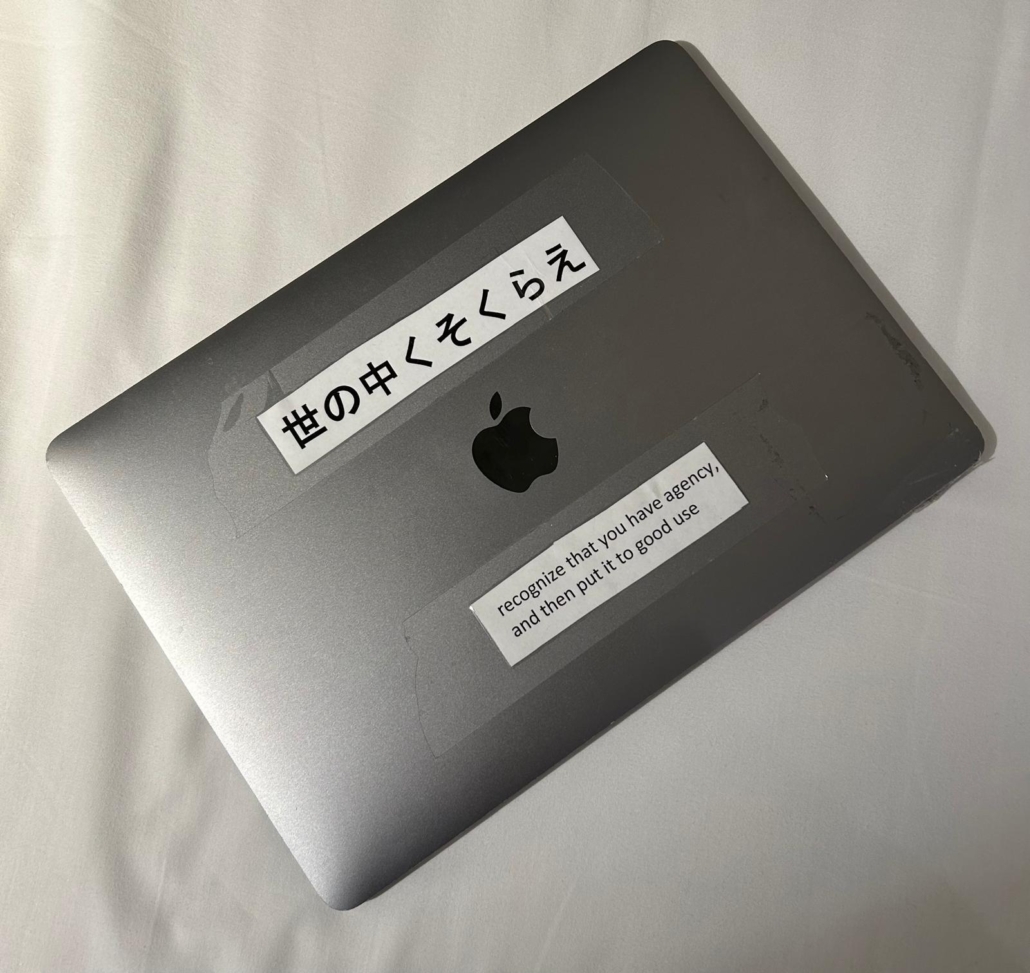
After observing laptops in various settings, I started thinking about my own choices. Whenever I get a new laptop, I personalize it with stickers, quotes, or slogans, partly to identify it in a house filled with similar devices but also as a form of self-expression.
Currently, my laptop cover features two primary messages: one in Japanese and one in English. The Japanese text, when translated, reads, “Fuck The World,” a phrase that resonates with my rebellious streak. The English message urges people to recognize their agency and act upon it. These two statements—one defiant, one motivational—exist in tension yet complement each other. Interestingly, only one person has ever asked me about them: a native Japanese speaker.
This experience highlights an interesting aspect of laptop semiotics: while stickers are often meant to be seen, their impact depends on who looks and whether they engage with the message. Some people use their laptop covers to start conversations; others use them to signal affiliation without inviting dialogue.
The Power of Laptop Semiotics
While some people deliberately choose to leave the covers of their laptops bare, this lack of customization is also a form of signaling (e.g., a nod to professionalism, neutrality, or disinterest in visual identity).
More broadly, how we decorate (or don’t decorate) our laptops reflects a subtle but meaningful form of self-expression.
Like all personal choices, laptop decoration exists in a space between intention and interpretation. Someone might slap a sticker on their laptop simply because they like the design, but others may see it as an endorsement of a cause or an affiliation. Even seemingly neutral choices—such as a plain cover in a room full of professionals can send messages about personal style, priorities, or professional identity.
What’s on a laptop can also shape social interactions. A bold political sticker might spark conversation or create distance. A heavily customized cover could signal creativity and individuality, while a minimalist aesthetic might suggest a preference for sleek professionalism over personal branding.
Ultimately, the stories we tell through our laptops are shaped not just by what we choose to display, but by how others interpret those choices.
Whether carefully curated or casually applied, the images on our laptop covers are part of an unspoken dialogue about identity, values, and belonging.
Photo Credit
Title: My laptop cover
Photographer: Jeffrey Ian Ross