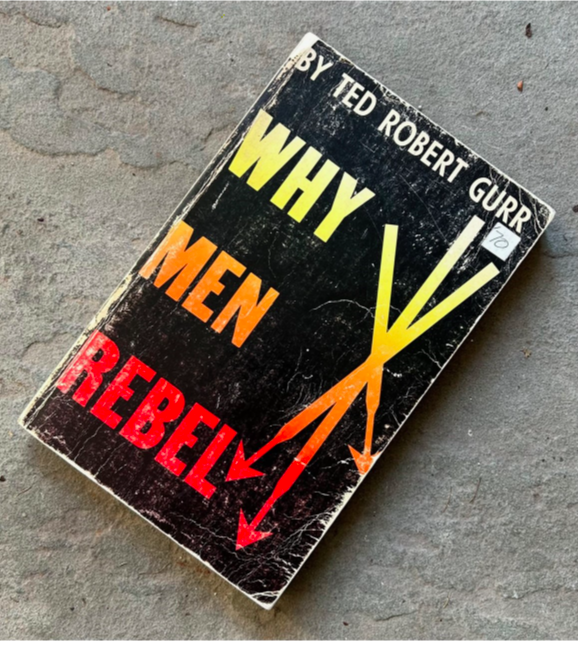
On the importance of Ted Robert Gurr’s WHY MEN REBEL
I periodically ask myself what are the top 10 books, movies, songs, pieces of visual art, television series, etc. that have influenced me and why? This exercise forces me to reexamine these items more closely, critically answer why I thought they were important, and why they may be better or worse than other creative works on my lists.
More specifically. a number of books have significantly shaped my scholarship, including not only what I’ve chosen to study, but how I conduct research on that topic.
After considerable reflection, one of my top books is Ted Robert Gurr’s, Why Men Rebel (1970). His seminal scholarship (and other publications that he authored, co-authored, edited or co-edited) motivated me to reach out to him as I was completing my bachelors degree, express an interest in doing a masters under his guidance, and for Gurr to recruit me as his first graduate student at University of Colorado Boulder, where he relocated to in the mid-1980s.
During my graduate career, not only did I complete my masters thesis and doctoral dissertation under Gurr’s direction, co-author with him, but benefited from Gurr’s mentorship too.
Turning to the book, Why Men Rebel, was important during its day (garnering the American Political Science Association Woodrow Wilson best book of the year award), but as testament to its importance today, and as of this writing Why Men Rebel has 11,523 citations on Google scholar.
In short, Why Men Rebel attempts to answer a very simple question, one that has become increasing important to ask over that past five decades.
The book consists of ten chapters beginning with a chapter titled “Explanations of political violence” and ending with one on “Causes and Processes of Political Violence.” At the time this was one of the most comprehensive books. After an extensive review of competing explanations, drawing most from the social sciences, Gurr settles on the concept of relative deprivation (as the most important reason why individuals and collectivities engage in political violence against the state.
He begins by arguing that that frustration-anger-aggression undergirds most political violence, but not everyone who experiences this state of affairs automatically engages in violence. Moreover, frustration-aggression (for short) must be coupled with a feeling of relative-deprivation (i.e., a perception that compared to others who are similar to you and your group, your lot in life is less than satisfactory). Gurr then introduces the reader to the importance not just of different contexts, but how important elements of violence and the processes that lead up to it like scope, intensity, and duration commingle and effect the pattern of violence.
This background information is necessary to understand why some types of political violence (e.g., insurrections, oppositional political terrorism, coups d’etat) are more frequent in some countries or societies, during different periods, than others. And why in other contexts all that we may see and experience are things like acts of resistance, political protests, etc.
Undoubtedly, and in hindsight the book has a handful of drawbacks and criticisms.
To begin with the book is half a century old. And thus a considerable amount of scholarship (e.g., biological) has been conducted since that time, some of which has competed with Gurr’s explanations why people decide to engage in political violence against the state.
Others have, in my opinion, wrongly inferred that the title of the book meant that Gurr’s explanation was directed towards men, or that he was somehow gender blind. Moreover, those expecting a page turner will not find it here. On the other hand, the book is methodical, sometimes boring, but this is to be expected with this kind of careful scholarly analysis.
Overall the advantages outweigh the drawbacks. To begin with Why Men Rebel is one of a handful of comprehensive explanations in an increasingly crowded scholarly field. Gurr’s approach was also truly interdisciplinary. Per Gurr’s style, he reviewed a considerable amount of social science scholarship that dealt with this subject, pointed out its merits and shortcomings, and then outlined a series of hypotheses amenable to empirical testing. Unlike many scholars who produce similar kinds of work, and to his credit, not content to leave his work as a a book treatment, Gurr subsequently invested considerable resources testing the numerous propositions statistically and modified his perspective when the evidence was not compelling.
Why Men Rebel is worth reading not simply as a parsimonious explanation for political violence, but as a model of comprehensive social science scholarship.



 @ Tony Webster