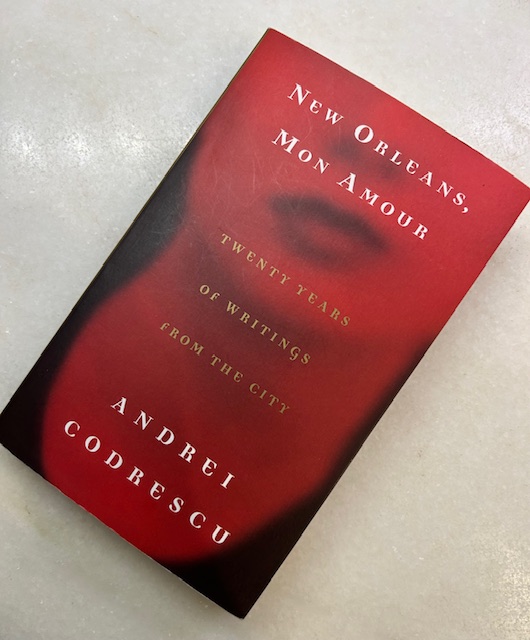
Reading Codrescu’s NEW ORLEANS, MON AMOUR
Apéritif
One of my favorite books is New Orleans, Mon Amour: Twenty Years of Writings from the City by Andrei Codrescu. A poet, essayist, novelist, and professor emeritus at Louisiana State University, Codrescu is also widely known for his commentaries on National Public Radio.
Published in 2006, New Orleans, Mon Amour is primarily a collection of previously published essays (i.e., sixty-six chapters divided into six sections) spanning two decades on the city. Most run two to six pages. In these pieces, Codrescu describes selective aspects of New Orleans, including its bars, its politics, its strange characters, and the rhythms of everyday life, in an intimate and personal way.
I have visited New Orleans several times, mostly as a tourist and conference attendee, and once conducting research for a now-abandoned biography of the surrealist photographer Clarence John Laughlin (1905–1985).
Mise en Place
Codrescu’s central job is to acknowledge, but push back against, interpreting New Orleans as a series of myths that outsiders, including tourists, have and consume about the city. This includes the numerous spectacles they encounter, such as Mardi Gras excess, the New Orleans Saints football team (not to mention the frequent Super Bowl games held there), and jazz on Bourbon Street.
Codrescu’s counter-argument is embedded in his method. Having lived in the city for nearly two decades, he writes not as a visitor being entertained but as someone whose daily life is entangled with the city’s contradictions. The book’s thesis, never stated but consistently demonstrated, is that New Orleans can only be understood by living there and engaging with its people, customs, and events. This process enables Codrescu to move beyond the tourist gaze, which is typically superficial and superfluous.
This argument gains added weight because Codrescu is a kind of permanent outsider. He emigrated from Romania (Transilvania, no less), built his reputation partly through NPR commentary aimed at a national audience, and spent the bulk of his academic career at LSU rather than at a New Orleans institution. His insider status was earned rather than inherited, which gives him a particular vantage point: close enough to see what tourists miss, self-aware enough to know he is still reading the city rather than simply living inside it.
The Roux
The short-chapter format serves the book’s argument. The complexities of New Orleans are difficult to interpret, and Codrescu’s fragmented, episodic structure mimics the city’s own rhythm, which includes intense encounters followed by laid-back scenes. Because the chapters are largely self-contained, readers who find a particular vignette less engaging can skim and move on without losing the broader thread.
Étouffée
The best essays demonstrate Codrescu’s method at its sharpest. “Against Synchronicity” argues against the New Age tendency to read meaningful coincidence into New Orleans’s density of strange encounters. The city produces lots of bizarre juxtapositions, and pattern-seeking annoyingly prevails. One may not find his argument fully convincing, but it forces a genuine reckoning with how we interpret urban strangeness.
“Prosperity and the Devil” works through a deceptively simple anecdote: a neighbor repairing his house with old-fashioned tools inadvertently drives rats into surrounding homes. The essay uses this incident to explore the city’s paradox of maintenance and decay; the effort to restore one thing inevitably displaces damage elsewhere.
“Fried Rice” recounts the feud between novelist Anne Rice and Al Copeland, the founder of Popeyes. What makes the essay memorable is not the events, but what Codrescu draws from it: that in New Orleans, even cultural conflict gets refracted through food, property, and the specific grievances of adjacent neighbors.
The book’s longest chapter, “My City My Wilderness,” is its most ambitious. Codrescu moves through the city’s recurring themes, such as its unique food, crime, police corruption, and environmental vulnerability. Each theme is treated masterfully and in sufficient detail to give me the sense that I am experiencing the events myself.
The Gristle
The book’s recurring motifs, the humidity, local cuisine, topography, eccentric local personalities, and the figure of Baron Ludwig von Reizstein are occasionally redundant. Admittedly, this is a structural challenge when previously published essays are reprinted and brought together in collection form. What seems like texture across a couple of pieces can feel like repetition across sixty-six.
More substantively, Codrescu’s outsider-insider positioning, which is the book’s greatest strength, is also its quiet limitation. His New Orleans is densely populated with bohemians, academics, and the colorfully marginal. But readers should be aware that this is a very narrow demographic that pales against the city’s numerous working-class, immigrant, and poverty-stricken populations.
Café Brûlot
New Orleans, Mon Amour succeeds most when it resists the temptation to present the city in totally familiar ways. Codrescu’s best essays work the way good urban ethnography works. He is patient and attentive to the visual and sensory qualities of people, places, and things. His book is a useful reminder that there is always far more to the city than most visitors ever see—and that seeing more requires staying longer than most of us do.
The next time I visit New Orleans, I may try to visit some of the bars and restaurants Codrescu frequented. His book is a useful reminder that there is always far more to the city than most visitors ever see and experience, and that this requires staying longer, being more patient and aware than most of us usually are.