The Never-Ending Demonization of the American Inner City
This past week, Trump proposed an executive order aimed at increasing sentences for violent crimes (especially gun-related), quality-of-life offenses (e.g., public urination), the clearing of homeless encampments, and the removal of graffiti from national monuments in the District of Columbia.
Notwithstanding whether Trump has the legal authority to impose these sanctions, over the past century, a concerted effort by various political figures, political parties (especially Republicans directed against Democratically controlled cities), real estate developers, news media, popular culture industries, especially Hollywood has portrayed inner cities as entirely dangerous and rife with undesirable elements—ranging from poor and homeless people, immigrants, and criminals, to excessive garbage, graffiti, street art, and urban blight.
This narrative has not only shaped public perceptions but has also contributed to the growth of suburban and exurban areas, migration to these locations, and policies surrounding urban and regional development.
From political campaigns during the “War on Drugs” to crime-focused films, television series, and sensationalist news reports, these depictions have painted urban environments as a threat to the alleged safety and stability of suburban/exurban life. However, the impact of this narrative extends beyond migration trends—it has also led to policies that further entrenched inequality and stigmatized urban areas.
And the problem is too many people believe this shit.
This demonization has had tangible effects. Cities such as Detroit, Philadelphia, and Pittsburgh, once important centers of industry, commerce, and education, have experienced a significant decline. Their tax bases have eroded, forcing them to operate with fewer resources. As a result, public transportation systems, public housing, critical infrastructure, air quality, green spaces, neighborhoods, social and public health services, public safety, and retail and commercial areas have all suffered. In contrast, suburban areas have mostly flourished, benefiting from a growing tax base and better infrastructure, including highways that connect these communities to urban centers.
Media portrayals perpetuate the stereotype of the dangerous inner city. Popular nighttime television shows and films depict law enforcement combating street criminals in gritty, crime-ridden neighborhoods. These narratives have shaped the perceptions of many, particularly suburbanites, rural residents, and exurbanites, regularly exposed to these negative depictions.
Political figures, such as Donald Trump and right-wing pundits, have capitalized on this fear, tapping into the anxieties of the middle class. They have helped fuel a larger societal divide among urban, suburban, and rural America by framing the inner city as a place of chaos and danger.
However, it is essential to acknowledge that while certain parts of cities struggle with poverty, crime, etc., these issues are complex and multi-faceted. The notion that entire cities are dangerous oversimplifies the reality. Most cities are socio-economically, ethnically, and racially diverse, with many thriving neighborhoods and cultural hubs. Moreover, the focus on urban decay often ignores the challenges suburban and rural areas face. For example, these latter areas also have their own pockets of poverty and violence, which are frequently overlooked by the media and our politicians. Dangerous enclaves exist not only in cities but also in less densely populated regions.
While political and media forces have unfairly demonized inner cities, it is crucial to understand the full scope of urban, suburban, and rural challenges. Addressing urban decline requires a nuanced approach that considers the real struggles of city life and the broader political, social, and economic contexts in which these issues exist. The truth is that when it comes to cities, especially the inner city, not everything is broken. It’s time to drop the stereotypes and call out the tropes used and how false they are. These portrayals are too simplistic.
Photo Credit
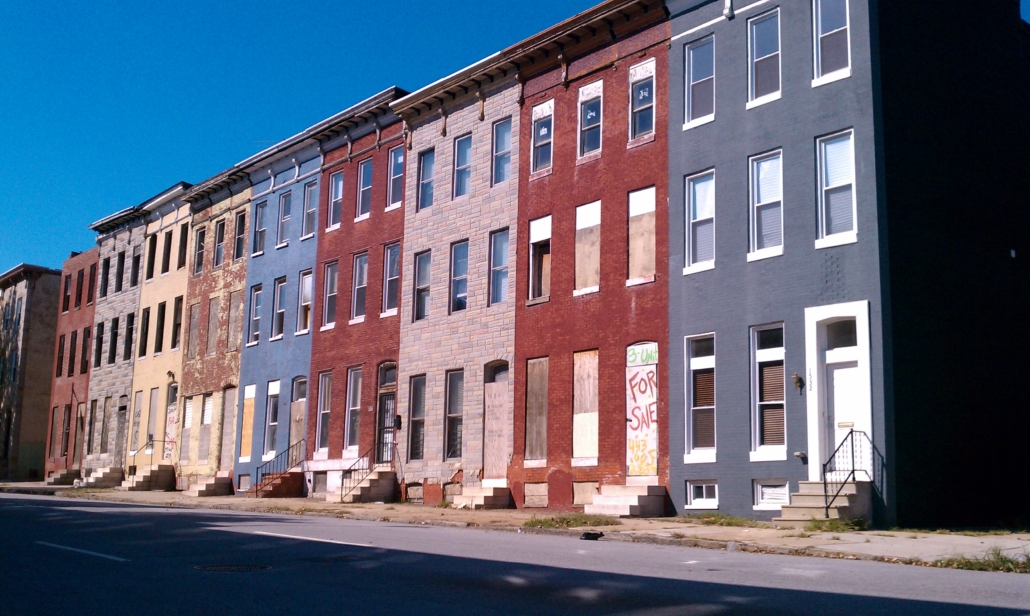
Photographer: Rd Kohler
Title: Baltimore Row Houses Near Bond Street

 Creative Commons