
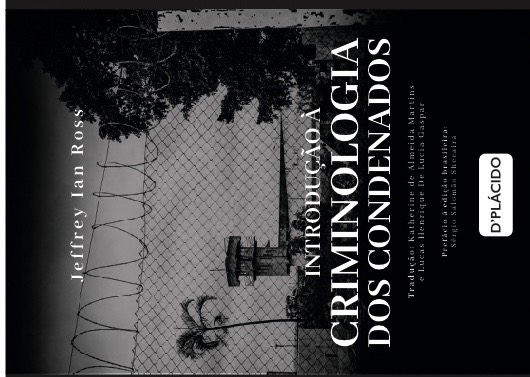
INTRODUCTION TO CONVICT CRIMINOLOGY Now Available in Portuguese
The Portuguese edition of Introduction to Convict Criminology (2024) comes as Brazil’s prison population is climbing again after a COVID-era dip. Published as Introdução à Criminologia dos Condenados by @editoradplacido, the book brings Convict Criminology to a growing Portuguese-speaking audience at a time when Brazil’s prison system faces enormous challenges. There is a relatively small but growing group of Brazilian scholars, activists, and practitioners who are engaging seriously with CC.
As the Beatles put it, I get by with a little help from my friends. The same was true when Francesca Vianello and I edited Convict Criminology for the Future. It was translated into Portuguese and published as A Criminologia dos Condenados e o Futuro (2021), and the same is true of this book.
Special thanks to @katheamartins and @delucialucas for their excellent translation, and to @SergioSalomaoshecaira for writing an engaging preface and coordinating the project. I’m very grateful to all three for helping bring the book to a Portuguese-speaking audience.
Brazil is, in many respects, an epicenter of contemporary prison problems, a subject I discussed in an earlier blog post. Since then, things have not gotten better. In fact, the number of people held in Brazil’s correctional system has continued to rise, although the pattern has not been one of uninterrupted growth.
In 2021, according to SENAPPEN (Brazil’s National Secretariat for Penal Policies), Brazil had approximately 680,000 people incarcerated. By the first half of 2025, that number had risen to nearly 706,000 people held in prisons and other custodial facilities. At the same time, Brazil’s broader correctional population (including people serving sentences under house arrest, with or without electronic monitoring) had reached 941,752. By the end of 2025, the number physically incarcerated had risen further to 727,301, while the total correctional population reached 960,976.
Overcrowding remains a major problem. In 2021, Brazil had approximately 468,000 prison places for nearly 680,000 incarcerated people, a deficit of about 212,000 places. More recent SENAPPEN data similarly show a substantial gap between the number of people held in physical cells and the system’s capacity.
Brazil has the world’s third-largest prison population, behind the United States and China. Its trajectory, however, is more complicated than a simple story of continuous growth. Incarceration fell substantially during the COVID-19 period and remained below its 2019 peak through 2023, before beginning to rise again.
These conditions make Convict Criminology particularly relevant to Brazil. At its core, CC seeks to bring the knowledge and experiences of people who have experienced imprisonment into criminological scholarship and debates about prisons and punishment. A Portuguese-language edition of Introduction to Convict Criminology (Introdução à Criminologia dos Condenados) makes those ideas more accessible to Brazilian scholars, students, and others interested in understanding and improving the country’s correctional system.
I hope the Portuguese edition will contribute to the growing conversation in Brazil about prisons, punishment, and the role that people with lived experience of incarceration can play in understanding and addressing these problems.







 @ Tony Webster

