Why do the Hudson’s Bay Blanket Stripes Travel So Well?
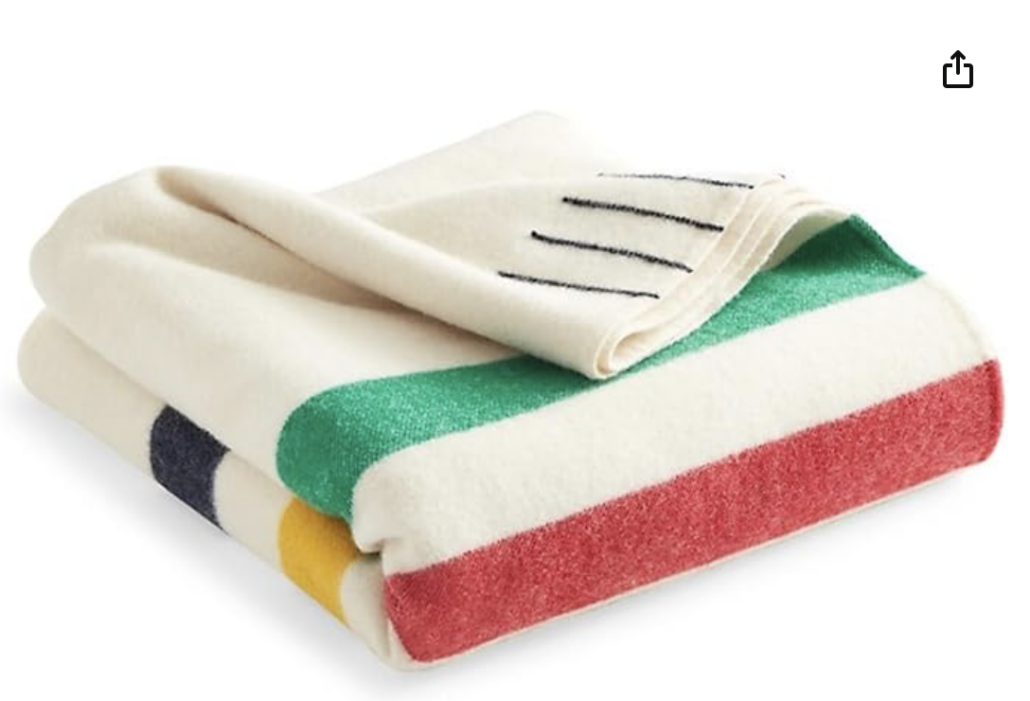
Almost a half-century ago, one of the first purchases I made in preparation for leaving my parents’ house was a Hudson’s Bay Company wool point blanket.
I walked into the HBC department store at suburban Fairview Mall, found the item with its iconic wide green, red, yellow, and indigo horizontal stripes on a white background, and paid what felt like a lot of money at the time.
Most things I owned in that apartment are long gone, but I still have the blanket.
But lately, I’ve noticed an increase in items for sale, including pillows, footstools, outerwear, and luggage, that carry the HBC multistripe wool blanket pattern. Some, including pickleball sets, cornhole games, tote bags, aprons, umbrellas, beach towels, cedar strip canoes, Muskoka chairs, outdoor cushions, and decorative paddles, have migrated into kitsch territory as part of Canadian Tire’s Summer 2026 collection, the first assortment the company designed itself after purchasing the HBC brand assets for $30 million following bankruptcy.
This raises an important question: why do some visual identities outlast others?
The Hudson’s Bay blanket is a useful case. In the late eighteenth century, the HBC (formed in 1670 and granted a monopoly over the fur trade in what would later become Canada) commissioned the production of wool blankets from mills in Witney, England. The pattern was not originally conceived as branding, visual, or graphic identity. It emerged from production realities. Early dyes and manufacturing processes limited what could be reliably produced at scale, and durability mattered more than symbolism. The wool was dyed before spinning, embedding color directly into the fiber and helping the blanket resist fading and wear.
Over time, the pattern migrated beyond the blanket. It appeared on packaging, marketing materials, retail displays, clothing, and eventually a wide variety of products sold under the brand. It became a symbol of the HBC.
About the pattern. The colored bands are comparatively simple, provide a strong contrast with the white background, are legible from a distance, and are recognizable regardless of the item on which they are placed and the size of that item.
These attributes enable the HBC blanket design to survive changing technologies and tastes.
But I don’t believe that these factors alone explain why this pattern has lasted so long. Design strength may get something into the conversation, but something else keeps it there.
In the case of the HBC blanket, the institutional history of the HBC enabled this to happen. The HBC was not simply a retailer. For generations, it occupied a central role in Canada’s economic development and territorial expansion. Throughout the corporation’s 335-year-old history, the blanket remained one of its most visible and continuously sold products. That kind of staying power is not achieved from good design alone. It’s accomplished by being sold by an institution that became inseparable from a national story.
Along the way, the pattern accumulated meanings that extended far beyond its original function. It began as a trade good, evolved into a branded product, and eventually became a cultural symbol that could be detached from the blanket itself and remain recognizable.
Once a visual form reaches that stage, it acquires a degree of independence from its original intent. Thus, the pattern can migrate onto all sorts of items because observers and consumers already understand what it signifies.
There is also a feedback loop at work. The longer a design survives, the more opportunities it has to be reused and reinterpreted. Each new appearance reinforces familiarity. Each new audience encounters it in on different items. Over time, continued visibility begins to look natural, even though it is the product of repeated cultural, commercial, and institutional selection.
This dynamic extends beyond the Hudson’s Bay blanket. The sustained visibility of selected pieces created by street artists like Banksy, Shepard Fairey, and Kenny Scharf, for example, depends not only on the work itself but on the museums, galleries, publishers, collectors, retailers, and media organizations that continue to circulate it. Systems of reproduction sustain recognition. Take those systems away, and most strong work fades into obscurity.
Most visual identities dissipate, not because they are poorly designed but because the institutions, markets, and cultures that sustain them disappear. What the Hudson’s Bay blanket demonstrates, and what I keep coming back to when I see the stripes on so many items, is that visual longevity is rarely a property of design alone. Strong design may make a symbol recognizable. But symbols endure only when successive generations continue to find reasons to reintroduce them into everyday life.