
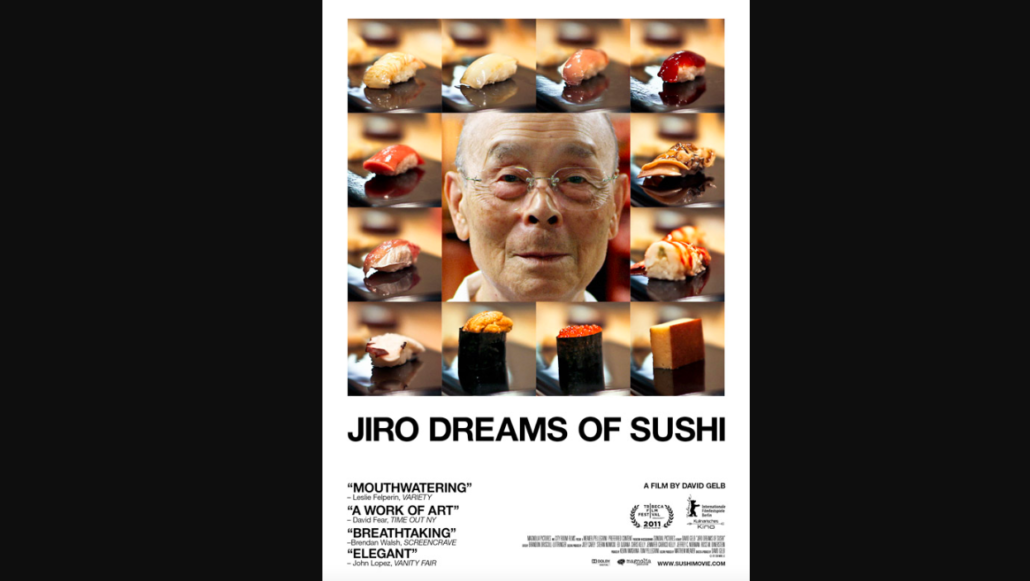
Learning from JIRO DREAMS OF SUSHI
Numerous films focusing on Japanese cooking or chefs have been released to Western audiences.
One of the more recent iconic and celebrated is David Gelb’s 2011 documentary, Jiro Dreams of Sushi.
The movie reviews the work (and to a lesser extent the life) of Jiro Ono, a humble and modest 85-year old Tokyo based sushi master chef and owner of Sukiyabashi Jiro, his ten seat restaurant (that once held the distinction of earning three stars from the famed MICHELIN review guide).
Although more then a decade has passed since the movie’s release, what makes this film interesting? Lots of things.
For sushi lovers there are copious shots of Jiro and his team carefully preparing sushi, and placing these creations on plates. To a lesser extent rarely seen sushi preparation practices like smoking fish with straw and treating nori over propane flame are shown to the audience. We also witness scenes from the early morning fish auction at the Tsukiji Fish Market where Jiro and other Tokyo based chefs inspect the fish and seafood, and then buy the food they are going to serve that day. Interviews with his primary fish monger (Mizutani Takashi) and rice dealer (i.e., Hiromichi) are also part of this dynamic.
Over the course of 80 minutes viewers are introduced to Jiro, who has devoted the majority of his life to perfecting his craft of making sushi, and to a lesser extent his grueling training of others (in particular his two sons, Yoshikazu and Takashi) in the fine art of sushi making. We briefly learn about his father, and the unusual upbringing he had. In particular, at the age of nine he was abandoned by his father, and started working in a sushi restaurant to support himself.
Unquestionably both the movie and the main character have some flaws.
• It may have been helpful if there were a sprinkling of interviews with other sushi chefs (i.e., his competition) or customers. This may have provided an additional sense of balance to the story. Instead Gelb appears content to give a rather complimentary examination of Jiro and his practice. Thus, the film can be easily construed as a sophisticated tribute or commercial.
• The film neither mentions his wife, nor considers the struggles his sons made in choosing to follow their father’s footsteps.We learn that despite his sons wanting to either go to university or be an airplane pilot, Jiro convinced them otherwise to join him at his restaurant. Moreover no mention is made of his wife. We don’t know if she is widowed, divorced, etc.
• Jiro Dreams of Sushi does not consider how the protagonist’s obsession (spending every waking hour of his life thinking about sushi) effects his family life.
• Although the film states that Jiro pioneered new techniques in the preparation of sushi and rice, it does not provide specific details. We also do not see any in-depth reflections from his mentors, etc.
Much like a well designed and prepared meal, however, the story is beautifully told. There is a balance, if not harmony, among the content, interviews, visuals, dialogue and music, focusing not just on Jiro, but his sons, his apprentices (shokunin deshi, in Japanese) and Yamamoto Masuhiro, a well-known and respected Tokyo based restaurant reviewer. There is also some social commentary towards the end of the film that deals with the challenge of overfishing.
The success of this movie may lie in the zeitgist of the decade in which it was release. Building upon Robert M. Pirsig’s, Zen and the Art of Motorcycle maintenance (1974), through Matthew B Crawford’s Shop Class as Soulcraft: An Inquiry into the Value of Work (2009), we learn about the pleasure of working with one’s hands. Similarly, Malcolm Gladwell’s Outliers: The Story of Success (2008), we learn what it takes to devote one’s self to one’s career.
It is hard to say that making sushi was Jiro’s calling, but he has put his heart and soul in to the practice of this Japanese culinary practice, and this seems to be where not only he made a living but derived a considerable amount of enjoyment doing this sort of thing. Key takeaways are
1. In priniciple, over time, and with sufficient dedication you get better at your craft.
2. Have high standards. For Jiro, this includes selecting and using high quality raw ingredients, the proper use of tools, and the manner in which the fish is cut, rice is prepared, etc. and served on the plates.
2. See yourself as a professional and elevate your craft.
3. Develop mastery in a profession, take time and an almost obsessive compulsion perfecting your craft.
4. Understand that you need to serve as an apprentice (itame in Japanese) first, and only after sufficient training, can one become a master skilled sushi chef (itame-san, in Japanese).
5. After you have become a master, pay it forward by taking on apprentices.
These lessons are generalizable to many jobs, professions and careers. The benefit are not necessarily financial but they do enable a sense of commitment, purpose and satisfaction.