Jeffrey Ian Ross
  • Blog
  • Publications
    • by Type
      • My Books
      • Articles
      • Chapters
      • Recommended Books
    • by Subject
  • Expert Witness
  • Consulting
  • Speaking
  • Media
  • Bio
    • Vitae
    • Teaching
  • Contact
  • Menu Menu

The Visual Evolution of Digital Age Protest Signs

May 11, 2025/by Jeffrey Ian Ross

Political expression takes many forms.

Although spoken and written words matter, provocative visuals often capture public attention more quickly and viscerally.

Admittedly, some visual content, such as television programs and Hollywood films, requires significant resources to produce. However, other forms, like graffiti, street art, and memes, are far more affordable.

Meanwhile, one often overlooked, enduring, and accessible form of low-cost visual resistance is the protest sign or placard.

Over the past three decades, protest signage has evolved into a more visually expressive and sophisticated medium of communication.

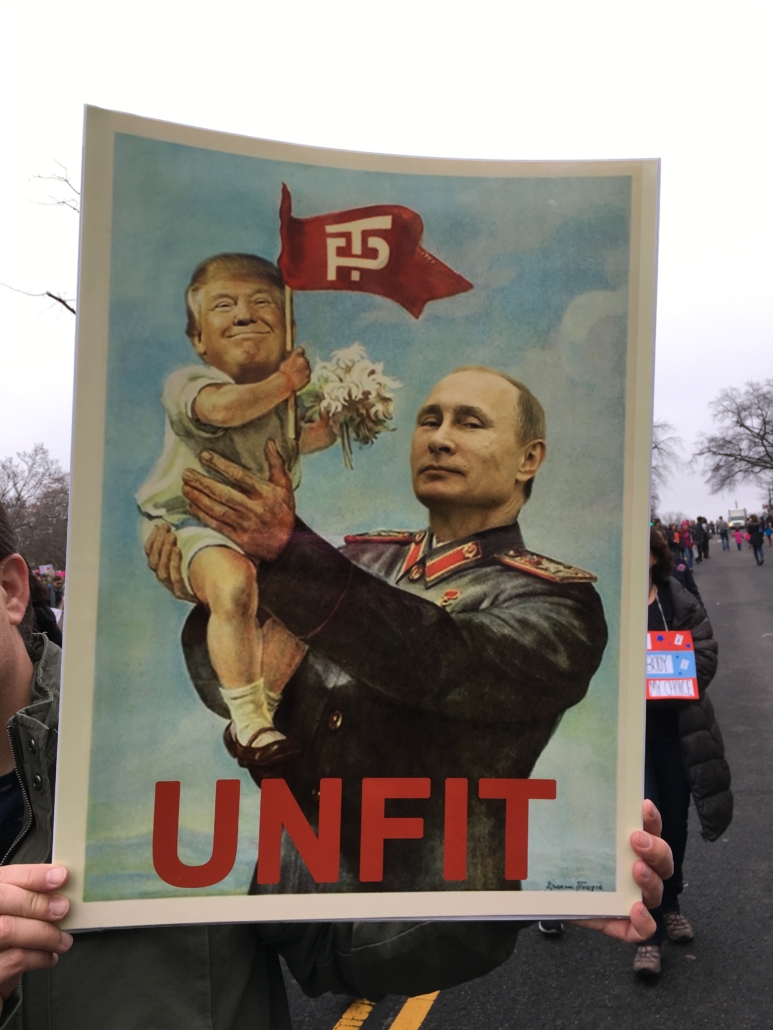
Increasingly, protest signs have become both physical objects and digital artifacts. In many respects, they are one of the most agile and immediate tools of grassroots communication. From the Women’s March to Black Lives Matter demonstrations to global climate strikes, hand-held placards have shaped the visual lexicon of 21st-century resistance.

No longer limited to quickly scrawled slogans on cardboard, today’s signs often incorporate photography, collage, stylized typography, and digital illustration. This transformation reflects not only changing aesthetic sensibilities but also broader technological and cultural shifts.

Individuals who want to create a relatively engaging placard no longer need to visit a print shop. The tools required to produce compelling visuals are now widely accessible. Design software like Photoshop, mobile apps, and AI-based image tools allows almost anyone with a laptop or smartphone to create professional-looking graphics. Affordable home printers and easy online purchase of poster board, stencils, and other materials have removed many logistical hurdles in creating compelling protest placards.

Yet despite the sophistication of these materials, most protest signs are inherently ephemeral. They are discarded, destroyed, or lost shortly after the event. In contrast, politically charged murals, graffiti, and street art may linger for weeks or years in the public realm. As with graffiti and street art, unless we are physically present at a protest, we depend on photographers, journalists, or participants to capture and circulate these images, often through social media.

Another aspect should be considered. It’s fair to say that, like some graffiti writers and street artists, protestors may now design their signs to capture the attention of people at the protest and a social media audience beyond. Thus, the line between political messaging and performance can be thin, raising questions about authenticity and the commodification of dissent.

In the end, thanks to accessible technology and widespread digital platforms, activists now possess the tools to create protest signs that, though materially fragile, can achieve enduring cultural visibility. A well-designed placard may disappear after the march, but its image can live on, influencing discourse far beyond the street.


Photo Credit


Title: Anti-Trump Protest Sign

Photographer: Jeffrey Ian Ross

Share this entry
  • Share on Facebook
  • Share on X
  • Share on LinkedIn
  • Share on Reddit
  • Share by Mail
  • Link to Instagram
https://jeffreyianross.com/wp-content/uploads/IMG_6901-scaled.jpg 2560 1920 Jeffrey Ian Ross https://jeffreyianross.com/wp-content/uploads/jeffrey-ian-ross-logo-04.png Jeffrey Ian Ross2025-05-11 13:04:422025-10-19 17:42:59The Visual Evolution of Digital Age Protest Signs
You might also like
Small but consequential victories: Convict Criminology becomes an official division of the American Society of Criminology
Addressing the diversity of American correctional facilities and systems
Questioning graffiti and street art as acts of resistance
On the possibilities of interactive graffiti and street art
In the struggle to #defundthepolice, where does the money go?
Reconsidering Hirschman’s EXIT, VOICE, AND LOYALTY in the context of the great resignation
Seven Popular Myths About Contemporary Street Culture
Misapplying appropriation, co-optation, commodification & fetishization

Most Popular Posts

  1. What’s in a name? Ex-convicts, formerly incarcerated or returning citizen?
  2. My beef with Person Centered Language
  3. Exploring how graffiti and street art calls attention to social justice issues
  4. A police union’s endorsement of Trump is not a happy one
  5. Should You Earn a PhD in Criminology/Criminal Justice or an Allied Field?

See all 10 →

Tags

Activism (44)
American Indians / Alaska Natives & First Nations Peoples (3)
Authenticity (24)
Books (20)
Clothing (10)
Colleges & Universities (40)
Convict Criminology (11)
Cooking & Cuisine (16)
Corrections (34)
COVID-19 (21)
Crime (28)
Crimes of the Powerful (60)
Criminal Justice (86)
Criminology (38)
Elections (14)
Expertise & Mastery (109)
Food (21)
Graffiti & Street Art (48)
Inequality (38)
Japanese Cooking & Cuisine (11)
Language (12)
Leaders (15)
Lived Experience (8)
Memories (11)
Movies & Television Series (6)
Music & Musicians (15)
Police/Policing (39)
Political Crime (21)
Political Participation (47)
Power (65)
Prisons (28)
Protest (17)
Public Space (71)
Race & Ethnicity (22)
Scholarly Disciplines (31)
Scholarship (70)
Semiotics (16)
Sound & Noise (5)
Strategy/Strategic Planning (14)
Street Culture (53)
Street Ethnography (8)
Tourism & Vacation (1)
Travel (1)
Travel, Tourism & Vacation (17)
University Pedagogy (39)
Urban Mobility (10)
Urban Public Space (75)
Vacation (20)
Year End Review (6)

X Logo Linkedin Facebook Instagram

© 2026 Jeffrey Ian Ross

Link to: Rank Ordering to Clarify What Matters Most Link to: Rank Ordering to Clarify What Matters Most Rank Ordering to Clarify What Matters Most Link to: The Continuing Relevance of Gil Scott-Heron’s “Winter in America” Link to: The Continuing Relevance of Gil Scott-Heron’s “Winter in America” The Continuing Relevance of Gil Scott-Heron’s “Winter in America...
Scroll to top Scroll to top Scroll to top