Enabling graffiti and street art in these crazy times?
Over the past fifty years, graffiti and street art have emerged as significant movements in public art and street culture, visible on all manner of surfaces throughout urban environments worldwide.
Predictably, this activity has elicited diverse responses from individuals and groups, ranging from admiration to condemnation.
Undoubtedly attention from different stakeholders influences the prevalence of graffiti and street art, and is effected by the local contexts in shaping this public art form.
Societal Responses and Effects
Reactions to graffiti and street art vary significantly. Many people, unless their property is affected, are indifferent often due to apathy or their preoccupation with other pressing concerns. On the other hand, reactions to graffiti and street art can influence its perception and prevalence, creating a recursive effect where attention can either amplify or diminish the activity. This awareness comes from diverse stakeholders, including admirers, detractors, and neutral observers.
Public Indifference vs. Active Engagement
Public indifference often stems from a lack of direct impact or preoccupation with the daily crush of pressing obligations. Conversely, active engagement can come in various forms, including but not limited to such as public exhibitions, media coverage, community projects, scholarship, book publishing, social media, and legal graffiti walls.
Positive attention (that which attempts to legitimate graffiti and street art) is often done by practitioners, who may seek to elevate graffiti and street art as respected forms of artistic expression. Negative attention (that which seeks to control, deter, or eradicate graffiti and street art) is typically spearheaded by community activists, social entrepreneurs, ghost buffers, politicians, and law enforcement, aiming to maintain public order and aesthetics.
Awareness and Its Impact
A key question is whether the responses to graffiti and street art condones and/or enables it, leading to increased activity (perhaps even motivating its practitioners to experiment with new styles, techniques, placement, etc.). Awareness can indeed impact the prevalence and nature of graffiti and street art, as heightened visibility and discussion may encourage more graffiti writers and street artists to participate, while also drawing more efforts to control it. For instance, research shows that cities with legal graffiti walls often see a reduction in illegal tagging, as writers and street artists have designated spaces to work legally.
Stakeholders and Channels of Influence
Different individuals, organizations, and channels of communication operating in various urban locations throughout the world have varying levels of influence. In New York City, for example, because of its long history of urban graffiti, galleries may play a significant role in legitimizing graffiti or more likely street art as an art form. Meanwhile, in places like Nuart, Norway, or Aberdeen, Scotland, annual street art festivals might be more impactful in fostering community engagement and international recognition.
Final Thoughts
The impact of societal responses and the role of different stakeholders in either amplifying or mitigating graffiti and street art are complex. The recursive nature of attention highlights the need for a nuanced understanding of how public art evolves in response to societal engagement. Understanding the motivations behind different viewpoints and the specific impacts of local contexts can provide deeper insights into the future of graffiti and street art.
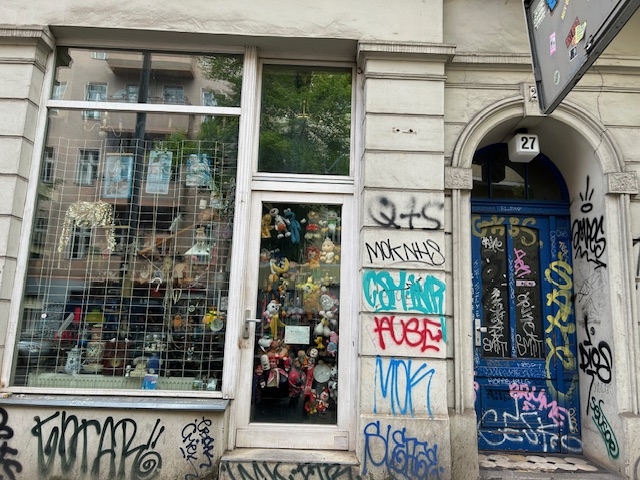
Photo credit
Title: Berlin-Flughafenkiez (2024)
Photographer: Jeffrey Ian Ross, Ph.D.