Portable Placemaking: Why We Mark What We Carry
Lots of people mark their property. Students write their names inside their schoolbooks. Soldiers print their names on their duffel bags. Players on the same sports team label gear that would otherwise be identical. In these settings, the goal is simple: tell my item apart from yours.
In recent years, people have added another layer. They now cover laptops, water bottles, phone cases, and suitcases with stickers and decals. Some of this activity is about identification, but much of it is about communicating something to others. In this respect, it’s one part theater, one part marking territory.
Urban planners have a term for the shared work of giving public spaces character: placemaking. The idea, associated with Jane Jacobs and William H. Whyte, is that people make a space their own by using it, shaping it, and leaving traces of themselves. Something similar happens with the objects we carry. Call it portable placemaking. We control very little of the space we move through, but we can claim the few things that move with us.
Portable placemaking does two jobs.
The first is practical. Laptops and water bottles are mass-produced and nearly identical. A heavily stickered laptop is less likely to be picked up by mistake, and it may be less attractive to a thief, because it is easier to identify and harder to resell. Criminologists and law enforcement practitioners recognize the logic of property-marking programs, which encourage people to engrave identification numbers on their valuables. Although the success of those programs is mixed, the same caution applies here. The instinct to mark is similar.
The second job is self-presentation. Erving Goffman wrote about “possessional territory,” the objects people treat as extensions of themselves and arrange around them in public. Stickers make that territory easy to read. A national park decal says where you have been. A university, a band, a cause, or a local brewery says where you belong, or where you want to be seen as belonging. A water bottle on a study table or a laptop in a coffee shop works as a small billboard aimed at strangers.
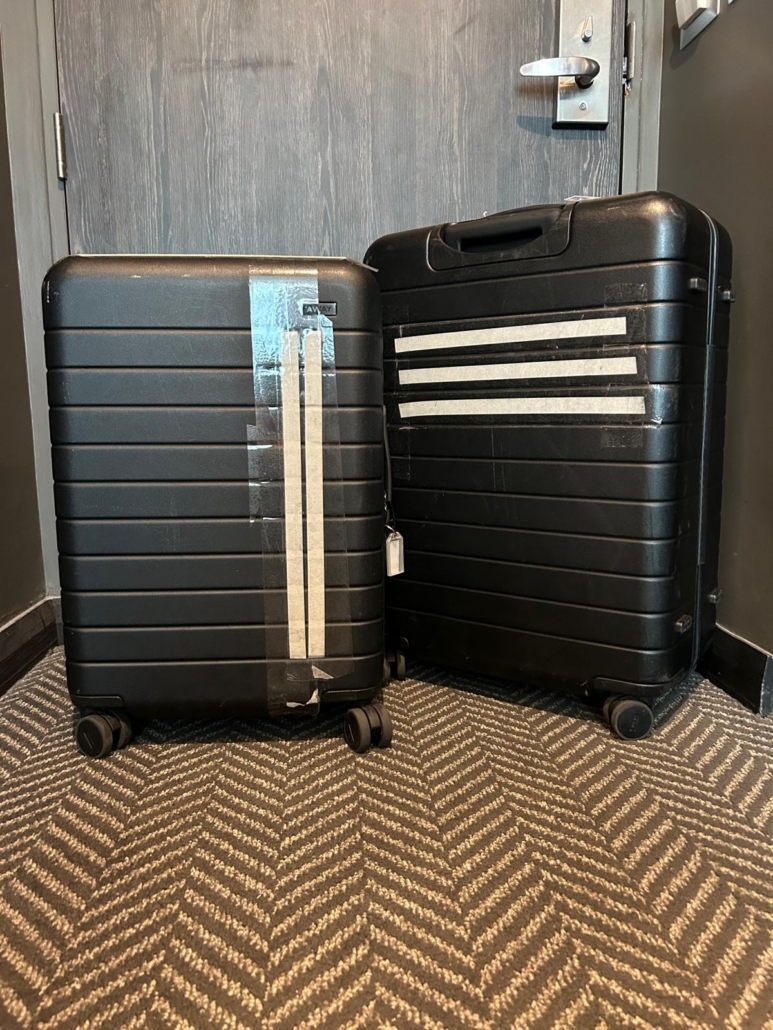
I’ve taken to marking my luggage with strips of masking tape, laid vertically and horizontally and sealed under packing tape so they look like racing stripes. They help me tell my bags apart from similar ones, and perhaps say something about me. I’m aiming for a minimalist look. The stripes also signal my desire to get the fuck out of the airport as fast as possible.
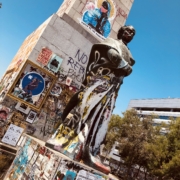
There is also a third angle. Anyone who engages in or studies graffiti and street art will recognize the medium. Stickers, or slaps, are a staple of street art. They are cheap, quick to put up, and easy to place on lampposts, signs, and newspaper boxes. The sticker on a laptop and the sticker on a lamppost come from the same impulse: leave a mark that says someone was here. The difference is ownership. On your own laptop, the mark is self-expression. On someone else’s property, it is vandalism or art, depending on context. Portable placemaking is the legal, domesticated version of what graffiti writers and street artists do to the city.
Most marks do both jobs at once. A suitcase covered in faded stickers and decals is easier to spot when it comes off the conveyor belt. It also looks like it has been somewhere.