
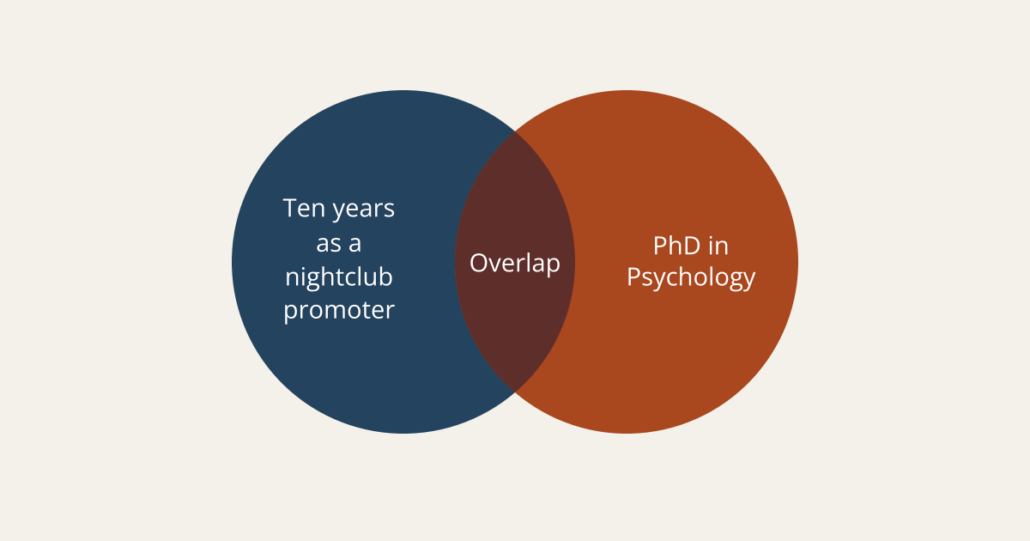
Ten Years as a Nightclub Promoter Is Not a PhD in Psychology
Recently I watched a YouTube video about Chris Williamson, the podcaster behind Modern Wisdom. The narrator said, “Chris worked as a nightclub promoter for over ten years, which basically meant that he got a PhD in Psychology.”
That statement made me wince. Sure, I understand the point. A decade doing this kind of work could teach someone a great deal about human behavior. But this isn’t the first time I’ve heard someone claim sustained experience equals a doctorate, whether it comes from doing a job or living through something.
As I’ve argued before, practical knowledge gained through experience differs from that obtained through a formal, rigorous doctoral education. Earning a doctorate involves deep engagement with existing research, learning different research methods, evaluating claims, and producing an original contribution to knowledge (usually in the form of a dissertation). Time spent in a particular environment does not confer those things.
I’m not saying a PhD makes someone an expert in every aspect of a subject, or that practical experience is less important than formal education. The problem is treating the two as interchangeable.
Someone can become very good at reading people without understanding why their judgments work, when they fail, or whether the patterns they see apply beyond their own setting. Experience can generate valuable insight. It can also reinforce assumptions, overlook counterexamples, and confuse what is familiar with what is generally true.
I see the same tendency in discussions about the lived experience of prison. Convict Criminology, which I helped found, rests on the premise that experience matters, and it does. Firsthand experience of incarceration can provide knowledge that outside observers struggle to acquire: the realities of institutional life, informal hierarchies, the psychological effects of confinement. Lots of scholarship on corrections struggles with these subtler processes.
But being locked up, or having worked in a jail or prison (regardless of how long and what kind of facility), does not make someone an expert in criminology, penal policy, or the causes of recidivism. Those subjects require different kinds of knowledge, evidence, and analysis.
The point is not to diminish lived experience but to recognize its limits. Encountering something, understanding it, and knowing how far that understanding extends are different things.
We should value lived experience without turning it into a universal qualification or dismissing people who lack it. We should also value academic expertise without pretending credentials make someone infallible.
Working as a nightclub promoter for over a decade might teach someone a lot about human behavior. A PhD might teach someone a lot about psychology. The two may overlap considerably.
But overlap is not equivalence.