Parking, power, and externalities
It’s a simple fact of life. People need and want to get places, and unless they walk everywhere, we need somewhere to temporarily or permanently store the objects that they use to assist them getting to their destinations.
Some of those items (e.g., bicycles, hover boards, razors, roller blades, and skateboards) are relatively easy to store, where as others (e.g., buses, cars, planes, and subways) are more difficult.
Over the past century, in modern cities, the horse and buggy gave way to public transit systems with buses, trams, streetcars, and subways and to private vehicles and taxis (and now Ubers, Lyfts, etc.), the latter of which dominate most urban landscapes. These vehicles are a blessing and a curse. They cost lots to operate, and create plenty of externalities (e.g., pollution, etc.).
If you are a driver and/or a pedestrian then at some point in time you are going to have to deal not just with vehicles in motion, but with parked cars. Parking a vehicle not only represents a place to temporarily store your valuable material possession, but this act is imbued with lots of other subtle considerations.
In many respects parking is often a contest, exchange, or game bounded by subtle forms of power, and contests over private and public urban space. This is played out and/or decided in questions like: where will we allow vehicles to park?; what types of vehicles will we permit to park?, when will we allow them to park?; should we charge them to park?, how much should this cost?, etc. etc.?
For example, when we talk about parking, we need to consider the size of the vehicle. This is especially noticeable when one travels outside of Canada and the United States. In general, it’s easier to park a car in European countries where the majority of cars are small versus the big gas guzzling cars on this side of the Atlantic.
Alternatively, many cities have very difficult to negotiate street parking restrictions at certain times of the day. In the morning during rush hour, the city will ticket cars that are illegally parked during the prohibited times, and within minutes they may be towed off to an impound lots deep in the suburbs. Although this is supposed to generate income for the city, many, often poor people, are unnecessarily victimized by this practice.
Eventually tickets accrue and the owner of the vehicle may determine that it is not worth it to pay off the fines, towing charges and storage fees, just to get their car out of the impound lot.
In the meantime, most cities enable car owners to park their cars at the side of the road, sometimes for a fee, to take up space that would otherwise be used for vehicular traffic. This public space costs money to maintain, and it is paid through tax dollars.
Moreover, many European cities (in countries like Germany, Italy, The Netherlands, Spain, etc.) have purposely constructed or financed above ground or underground parking garages, and restricted vehicular access to certain streets by closing off retail and business areas and creating pedestrian malls. (Both solutions to deal with traffic, the congestion that parking creates, and other externalities).
As we move into the post COVID-19 world, where some progressive municipal councils and leadership have temporarily turned some downtown streets into pedestrian malls, and enabled restaurant owners to have temporary outdoor structures on the streets (and the inevitable increase in electric vehicles), now is a good time to reevaluate not just the role of mobility solutions, but where we allow vehicles to park, and what kinds of externalities this situation creates.
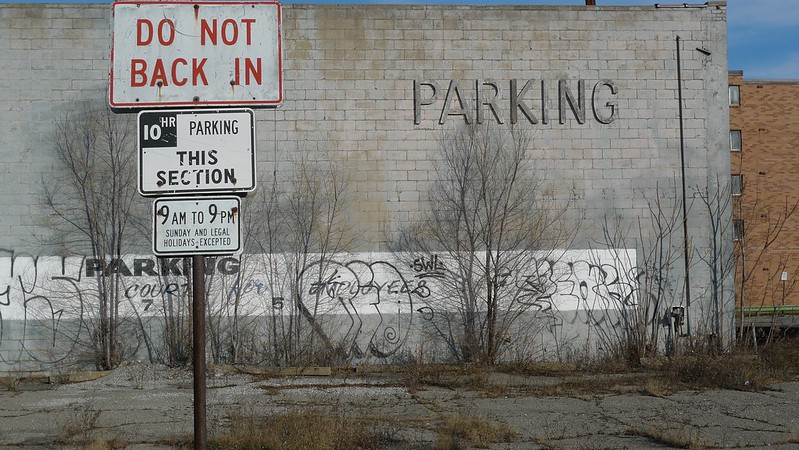
Photo Credit: Andrew Duthie
Parking Behind the Highland Park old municipal center