Stairwells Are More Than Passageways
The built environment has numerous underappreciated liminal spaces, and stairwells are among them.
If we examine these structures more closely, we notice many types. They vary based on their placement in a building (e.g., internal versus external), how many sides are surrounded by walls (e.g., open versus closed), their design (e.g., monumental, spiral, split scissors, cantilevered, etc.), and what they are made out of (e.g., concrete, wood, metal, stone, etc.).
While these differences define their physical characteristics, stairwells’ functions and roles go far beyond their structural diversity.
Although these spaces are often seen as purely functional, they also offer a range of benefits and roles in urban life.
Looking Beyond the Obvious
First, stairwells can serve a fitness purpose. Sometimes, people walk or run up and down the stairwells of structures as part of an overall exercise routine. During the COVID-19 pandemic, when gyms were closed and outdoor activity felt risky, some people turned to stairwells to get their steps in. The repetitive, vertical challenge they offer makes them ideal for cardiovascular workouts, and their accessibility ensures they remain a convenient option.
In popular culture, stairwells often serve as dramatic settings. Films like Die Hard and The Joker have used these spaces for tension-filled action scenes, including foot chases, daring stunts, amazing physical stunts, and gunfights. Their confined, vertical nature is ideal for storytelling, emphasizing movement and suspense.
Stairwells also have a social and cultural dimension in everyday life. Residents of crowded or government-assisted housing may find stairwells provide a temporary escape from noisy and overcrowded apartments. They can also act as informal gathering spots, especially in inclement weather, offering a semi-private space for conversations, social interaction, and community-building.
For some people, stairwells become places of reflection, where they can find a moment of solitude amidst the bustle of urban life.
Stairwells may also have a subversive edge. Graffiti writers and street artists occasionally use them as canvases, transforming sterile, functional spaces into vibrant galleries of self-expression and resistance. This kind of urban art improves the aesthetic nature of these areas and reclaims them, imbuing them with cultural and subcultural significance.
Conversely, stairwells are sometimes sites where illicit activities occur. Their semi-private nature makes them discreet venues for behaviors such as substance use. While these activities may be frowned upon, they underscore the role of stairwells as liminal spaces—neither fully private nor entirely public.
Acoustically, stairwells are unique. Their echo chambers amplify footsteps, conversations, and music, creating an auditory experience distinct from other parts of a building. Musicians and sound designers have occasionally taken advantage of these qualities, using stairwells to record or experiment with soundscapes.
Take the Stairs
Rather than seeing stairwells in a purely utilitarian manner, it’s essential to view them as areas that are more than mere conduits. Stairwells are versatile spaces with functional, cultural, and artistic significance.
Whether as places of exercise, artistic expression, social connection, or even acoustic exploration, stairwells have the potential to enrich the lives of those who pass through them.
By rethinking their significance, we can consider stairwells’ potential to inspire and connect, revealing their place as integral spaces in urban architecture and planning.
Photo Credit
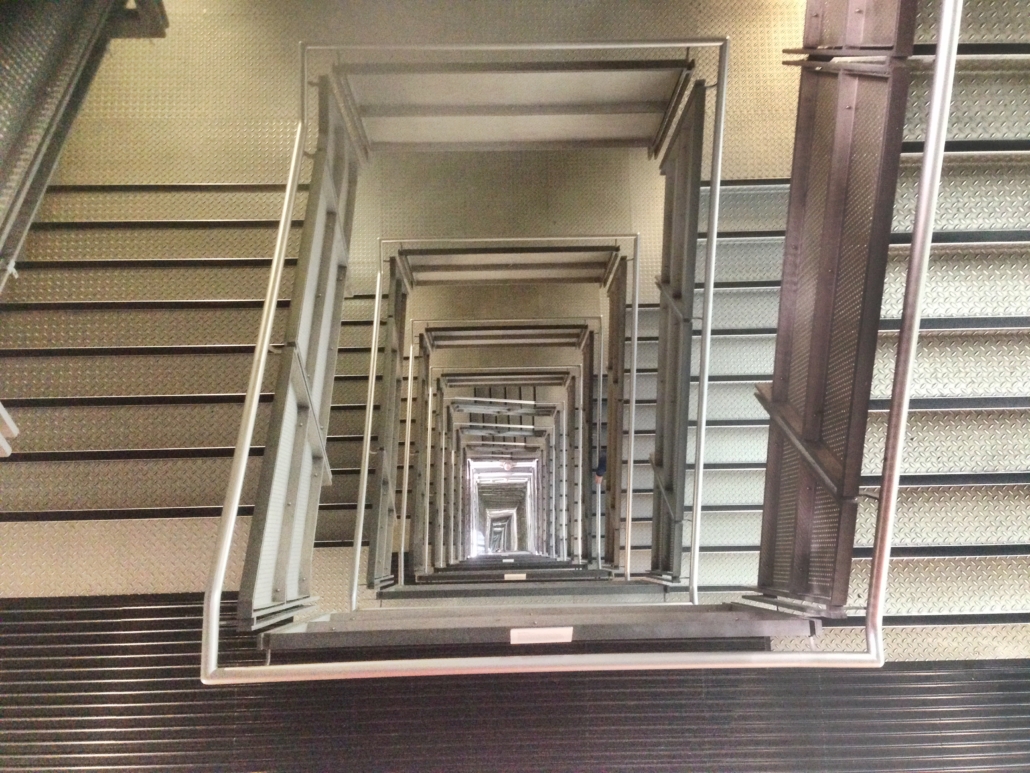
Title: Never ending stairwell?
(Baltic Newcastle upon Tyne)
Photographer: Dave Collie
 Creative Commons