Jeffrey Ian Ross
  • Blog
  • Publications
    • by Type
      • My Books
      • Articles
      • Chapters
      • Recommended Books
    • by Subject
  • Expert Witness
  • Consulting
  • Speaking
  • Media
  • Bio
    • Vitae
    • Teaching
  • Contact
  • Menu Menu

Rethinking Utility Markings in Urban Public Spaces

January 5, 2025/by Jeffrey Ian Ross

Cities and similar places provide numerous benefits, but these are also balanced with several drawbacks. One such issue is the debris, dislocation, and noise caused by periodic construction, repair, and maintenance of buildings, structures, and utilities.  

Less acknowledged amongst these externalities is the spray painting done to identify underground utilities.

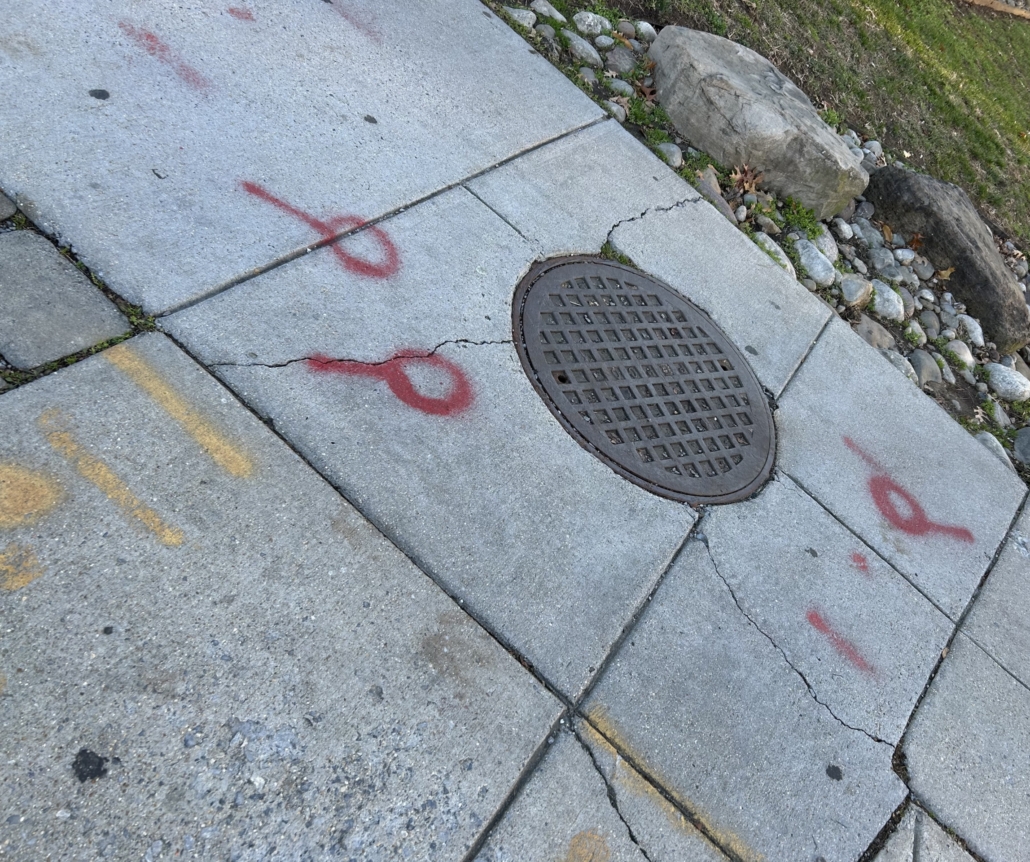
These assorted blue, orange, green, and red lines, squiggles, and symbols spray-painted on sidewalks, curbs, and streets are essential for safe construction practices and infrastructure maintenance. However, they are done long before construction and sometimes remain long after their purpose has been fulfilled, creating visual clutter in urban spaces.

Utility marking workers, easily identified by their orange safety vests, often apply the paint carelessly. They might reason that it’s not their neighborhood and municipalities have given them free rein to paint wherever they please.

Meanwhile, since their emergence half a century ago, unsanctioned graffiti and street art (mainly in urban areas) have often been vilified, while utility markings—go largely unnoticed. 

By contrast, graffiti (and street art) is frequently abated (painted over or removed) and condemned as vandalism, even when it showcases artistic talent, offers cultural or social commentary, and is generally tolerated by residents.

This double standard reveals a bias: utility markings, sanctioned by authorities, are tolerated, while graffiti and street art, perceived as unsanctioned, are dismissed.

What if utility companies adopt less invasive methods, such as biodegradable chalk, or commit to removing markings promptly after construction ends? And couldn’t we, as a society, reconsider graffiti—not as a blemish but as a potential enhancement to the urban landscape?

By reconsidering these double standards, we might find ways to balance utility and artistry, fostering a more equitable and vibrant visual landscape.

Photo Credit: Utility Markings in Wahington, DC/

Photographer: Jeffrey Ian Ross
Share this entry
  • Share on Facebook
  • Share on X
  • Share on LinkedIn
  • Share on Reddit
  • Share by Mail
  • Link to Instagram
https://jeffreyianross.com/wp-content/uploads/IMG_7073-scaled-e1736056508836.jpg 1920 2295 Jeffrey Ian Ross https://jeffreyianross.com/wp-content/uploads/jeffrey-ian-ross-logo-04.png Jeffrey Ian Ross2025-01-05 06:28:592025-07-03 00:28:40Rethinking Utility Markings in Urban Public Spaces
You might also like
Gimme Shelter? Examining the temporary structures that restaurants have built for outdoor dining during COVID-19
Creative Commons Preventing peaceful protests from being hijacked by people engaging in violence
The Plague of Motorized Scooters in our large Cities?
Crime rates, reporters, and experts. A cautionary tale
Why developing a literacy of graffiti and street art is important
Anti-Musk Graffiti & Street Art as a Rejection of Power, Capitalism, and Celebrity
Portlandia Redux: How using uninvited federal LEOs to police public protest will backfire
In Praise of Back Alley Mechanics

Most Popular Posts

  1. What’s in a name? Ex-convicts, formerly incarcerated or returning citizen?
  2. My beef with Person Centered Language
  3. Exploring how graffiti and street art calls attention to social justice issues
  4. A police union’s endorsement of Trump is not a happy one
  5. Should You Earn a PhD in Criminology/Criminal Justice or an Allied Field?

See all 10 →

Tags

Activism (44)
American Indians / Alaska Natives & First Nations Peoples (3)
Authenticity (24)
Books (20)
Clothing (9)
Colleges & Universities (40)
Convict Criminology (11)
Cooking & Cuisine (16)
Corrections (34)
COVID-19 (21)
Crime (28)
Crimes of the Powerful (60)
Criminal Justice (86)
Criminology (38)
Elections (14)
Expertise & Mastery (109)
Food (21)
Graffiti & Street Art (48)
Inequality (38)
Japanese Cooking & Cuisine (11)
Language (12)
Leaders (15)
Lived Experience (8)
Memories (10)
Movies & Television Series (6)
Music & Musicians (15)
Police/Policing (39)
Political Crime (21)
Political Participation (47)
Power (65)
Prisons (28)
Protest (17)
Public Space (71)
Race & Ethnicity (22)
Scholarly Disciplines (31)
Scholarship (70)
Semiotics (15)
Sound & Noise (5)
Strategy/Strategic Planning (14)
Street Culture (53)
Street Ethnography (8)
Tourism & Vacation (1)
Travel (1)
Travel, Tourism & Vacation (17)
University Pedagogy (39)
Urban Mobility (10)
Urban Public Space (75)
Vacation (20)
Year End Review (6)

X Logo Linkedin Facebook Instagram

© 2026 Jeffrey Ian Ross

Link to: 2024: The Year in Review—Surprises, Lessons, & a Few Doozies Link to: 2024: The Year in Review—Surprises, Lessons, & a Few Doozies 2024: The Year in Review—Surprises, Lessons, & a Few Doozies Link to: Why the Fun Lovin’ Criminals Matter Link to: Why the Fun Lovin’ Criminals Matter Why the Fun Lovin’ Criminals Matter
Scroll to top Scroll to top Scroll to top