
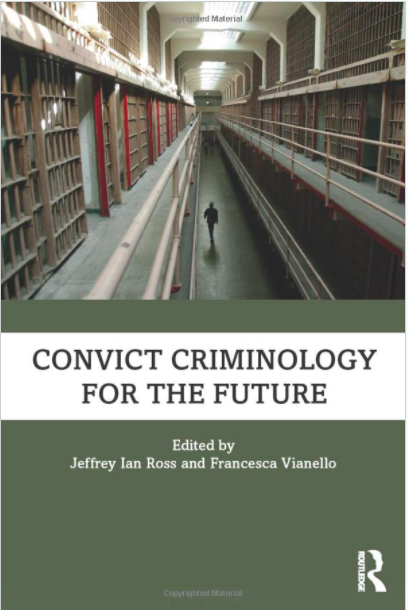
CONVICT CRIMINOLOGY FOR THE FUTURE drops: Why should you care?
Earlier this month Criminologist Francesca Vianello’s (University of Padua) and my co-authored edited book, Convict Criminology for the Future, was published by Routledge. Tracing its origins to a conference that was held May 31/June 1 last year, the book, consists of sixteen chapters (and a foreword by Shadd Maruna) written by a team of international scholars on the subject of Convict Criminology.
For those of you who are unfamiliar with Convict Criminology, it is basically a network of individuals who hold a Ph.D. or are on their way to earning a doctorate in Criminology/Criminal Justice or an allied field, and united around the idea that the convict voice is typically ignored in scholarly research and public policy debates. Additionally, scholars who are part of CC represent a diverse group, including those who have been formerly incarcerated, justice impacted, justice-free allies, and/or prison activists.
Since its origins in the 1990s the CC network has participated in public policy debates, taught and mentored scores of students behind bars and those who have been released, and published a considerable amount of scholarly and popular work. Part of this tragectory includes the establishment of the official Division of Convict Criminology (DCC) of the American Society of Criminology during the spring this year. And this new book is now part of development of this field and network.
Why is this book important? Francesca and I had numerous objectives when we held the conference and organized the book. One of them stemmed from our realization that very first book on the subject, Convict Criminology (Ross & Richards, 2003), was increasingly out of date, unnecessarily expensive, and there was a necessity for another edited book that reflected not only a stockkeeping of where CC has been, what it is currently doing, what the future may hold, but the increasing diversity of the people who make up Convict Criminology. Safe to say, Convict Criminology for the Future fulfills these complementary objectives.
In terms of content, what subjects does the book cover? Seven major areas are included:
• Historical underpinnings of Convict Criminology
• Adaptations to prison life
• Longstanding challenges for prisoners and formerly incarcerated people
• Post-secondary education behind bars
• The expansion of CC beyond North America
• Challenges to conducting research in correctional facilities
• Future directions in CC
The book is interdisciplinary in the sense that the contributors have training and experience working in different kinds of social sciencefields. Like the original edited book, many of the contributors who are formerly incarcerated or are justice impacted are presenting their work alongside supportive justice free colleagues who are allied with Convict Criminology. They bring this wealth of knowledge to the pages of this book and to the readers so they can make sense of the complicated world of corrections and to shed light on a viable way forward.
It’s always great to have a project that you and others worked so hard on come to fruition. It presents another opportunity to share what we know with others, address issues we have perhaps ignored, or failed to pay enough attention to, to gauge our progress, to make connections, and to assist others in the quest of making the field of corrections less brutal and more humane.
Doing edited books can be both rewarding and also an anxiety-ridden undertaking. This project had elements of both. More importantly it was a chance to work with people we always wanted to work with and to learn from them. It was also another opportunity to influence, to create, and to share.
The field of Convict Criminology has been all that to me. As the network has grown and matured it has provided fresh opportunities for more experienced members to share what they know, and to attract new people, with new and different ideas and energy, willing to tackle subjects of import to people behind bars, and those who have been recently released, those who study the subject of corrections, and those who want to reform the carceral enterprise. Things that we once thought were impossible and not attainable are all now part of the CC ethos.








 Creative Commons