Two Sundays In a Row
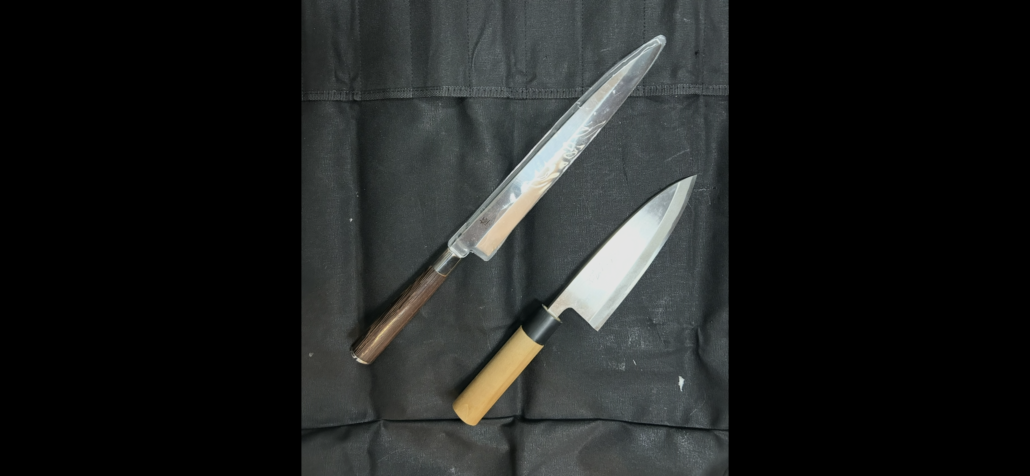
On my first visit, I brought my Japanese knives (the short deba and the long yanagiba), packed away in my knife case. Then, standing at the trunk of my car, parked across the street from the restaurant, I decided to leave them in the trunk.
I had been studying and cooking Washoku (traditional Japanese food) for six years. I held a Bronze-level certification from the Japanese government. I had an Instagram site where I posted the Japanese dishes and meals I prepared. I cook Japanese meals at least three times a week, and almost all the others have one dish that is Japanese or Japanese-inspired. And I had just returned from Japan.
But none of that stopped me from standing across the street, second-guessing my cutlery.
I was hoping he might agree to a stage (a short, unpaid stint in his kitchen), over the course of a few days, once a week, or even once a month. And if this worked out, maybe it might lead to a part-time paid position sometime in the future.
Two months earlier, my wife and I had eaten at the counter, and I’d struck up a conversation with the chef. He was rocking a Jiro Dreams of Sushi vibe, already in his seventies. I knew him by the quality of the food he prepared and served. His establishment was known to be the most authentic Japanese restaurant in town, and he had decades in the game.
I told him about my background. He seemed genuinely interested. Before we left, he told me to come by on a Sunday afternoon, and he’d show me some techniques. I thanked him and said I’d be in touch after the trip to Japan.
At the end of May, I called the restaurant. He sounded as if he remembered me, confirmed the invitation, and told me to come the following Sunday in the early afternoon. I hung up feeling excited about the forthcoming meeting.
When I walked in, he looked up and said he had forgotten I was coming.
My first thought wasn’t anger. It was: did I get the day wrong? Did I misinterpret our communications? I replayed the phone conversation in my head. No, I had the right day and time. But for a moment, I doubted myself completely before I understood what had actually happened: I had obsessed about something he had probably not thought about once since we last spoke.
He was unhurried, precise, entirely in his element. He talked about his life the way a man talks when he has nothing left to prove, seven generations of rice farmers in his family, an apprenticeship that began at fifteen, nearly four decades cooking in another big American city before this one. He estimated the day’s rice by feel. His sister, he mentioned, washes rice seven times.
The conversation was interesting enough. But I was also sitting there, increasingly aware that none of it was moving in the direction he promised and I wanted.
At some point, almost as an aside, he told me he doesn’t give instructions. He doesn’t like to tell his workers what to do. They learn through observation. Knowledge and skill development are acquired in his kitchen indirectly, through watching, proximity, and what he called, with a slight smile, a lot of bullshitting.
Toward the end of our conversation, I asked him directly: could I come in once a week, unpaid, for a few hours, just to observe and learn? He said there were no once-a-week arrangements like that. Maybe one day a week, paid positions, he said. I took that as a hopeful sign.
Before I left, he served me kalbi (flanken-cut beef short ribs), marinated in something I couldn’t quite identify. I asked about the marinade. He said the recipe was complicated. I pressed gently. He declined. I knew variations of the basic recipe were readily available online. I had made it myself a couple of times. Whatever he was protecting, it wasn’t a secret.
I had brought my knives, driven fifteen minutes, and listened to this bullshit for two hours, all for this?
As I was leaving, he said: Come back next Sunday for the staff meal.
Maybe I was misreading the whole thing. Perhaps this was how it worked. Acceptance was slow, indirect, a test of commitment. I decided to give it one more Sunday.
The following Sunday afternoon, I came back. Again, he had forgotten I was coming.
He was at the counter peeling a large, thick daikon, drawing a knife around the outside of it in one long, continuous motion, producing a single unbroken sheet (katsuramuki). It’s a technique that looks impressive to onlookers, but after some minimal practice, I can easily do it myself.
After about forty-five minutes, the staff meal was ready, curry ladled over ramen, served in ten bowls. He picked up a bowl, a glass of water, and a small bowl of miso, and sat alone in a corner near the door. I followed and sat nearby, leaving a space between us that I assumed a worker would fill. Nobody did.
Workers filtered in one by one, took bowls from the counter, ate in silence, and left when they finished. He neither introduced me to anyone nor did any of the workers come up to introduce themselves. Nobody spoke. I found myself wondering whether this was tradition or whether everyone hated his guts.
I showed him some photos from my Japan trip and mentioned the kaiseki meal we’d eaten in Kyoto. He looked at the photos and said that what I ate was not kaiseki. It was for tourists. He said it more than once.
After finishing his meal, he got up, muttered something about getting ready for dinner, and walked into the bathroom.
I sat at the counter for five minutes. What the fuck. No goodbye. I got up and left.
On the drive home, and a handful of times since, I tried to make sense of the interaction. To begin with, I don’t think the chef was intentionally being mean, but other things were happening.
He simultaneously expressed a considerable amount of bitterness towards his workers, other Japanese restaurants, the city he lives in, and venerated Japan with the intensity of someone who feels the place he actually lives has never given him his due. I suspect that he had spent decades feeling undervalued.
Perhaps he was operating according to a system of knowledge and skill transmission that has no mechanism for what I was asking, that in the tradition he came from, knowledge and skills move through years of proximity and hierarchy rather than formal arrangements, and that my certification and years of practice didn’t have any currency that he recognized.
Alternatively, maybe he was adopting the habit of many experts who are dismissive of the work and skills of others. The overall effect was an attempt to minimize my efforts in trying to master Washoku. It reminded me of the countless interactions I’ve had with contractors or tradespersons who throw a previous tradesperson’s work under the bus (a process called trade denigration), but when asked for specifics, provide nothing but mumbo jumbo.
In the end, it didn’t much matter which explanation was closest to the truth. What mattered was recognizing that whatever he knew, he had no interest in passing it on. That was enough.
Since then, I’ve eaten at the restaurant a couple of times. It’s still probably the best Japanese food in town, though I’ve had better in New York City and Los Angeles. On my last visit, I walked past the counter, and we exchanged glances. Nothing registered in his expression.
Three times, he had forgotten me. That said something about him. It also saved me from wasting my time.